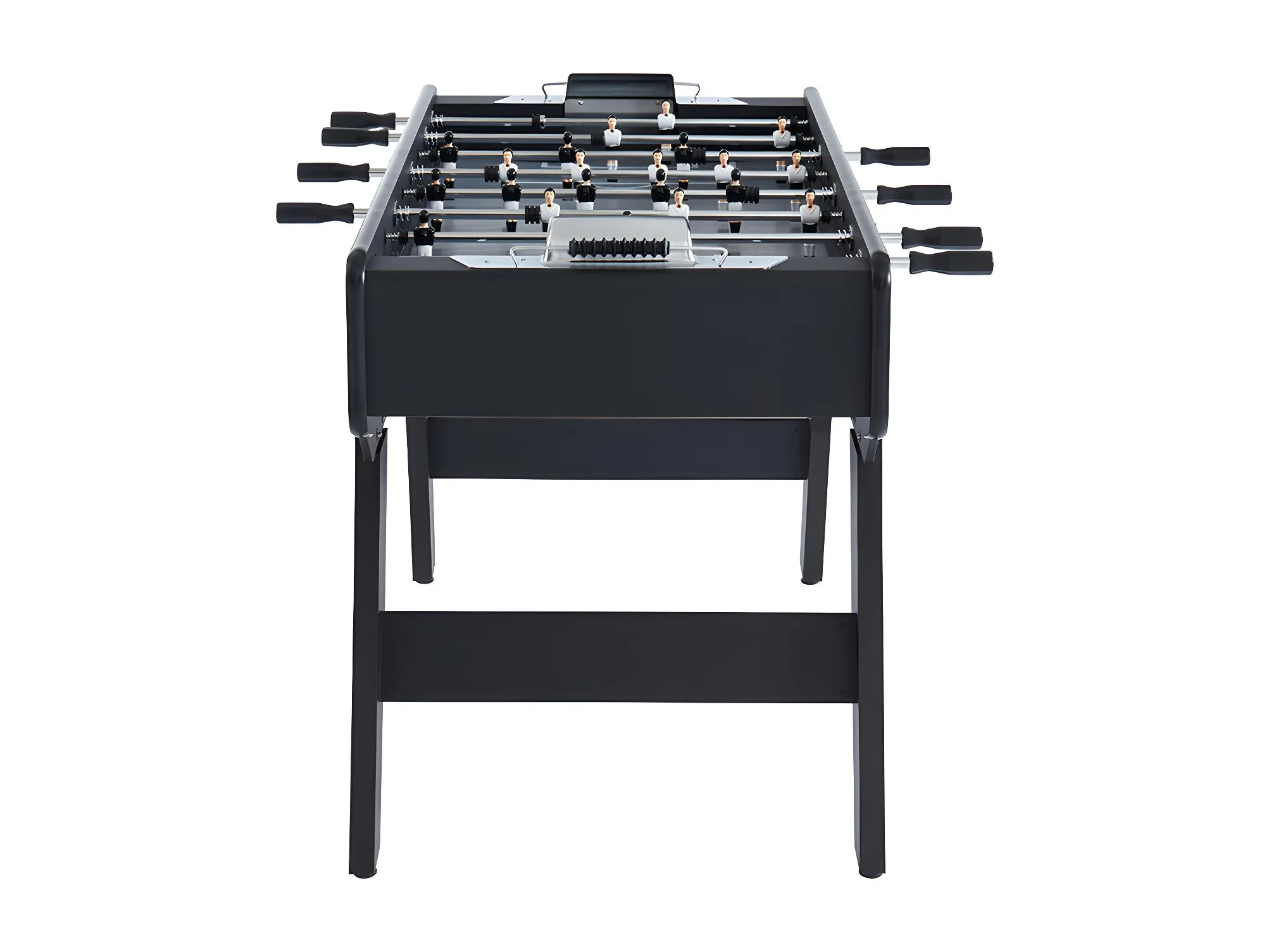
The Game-Babyfoot Soccer Table
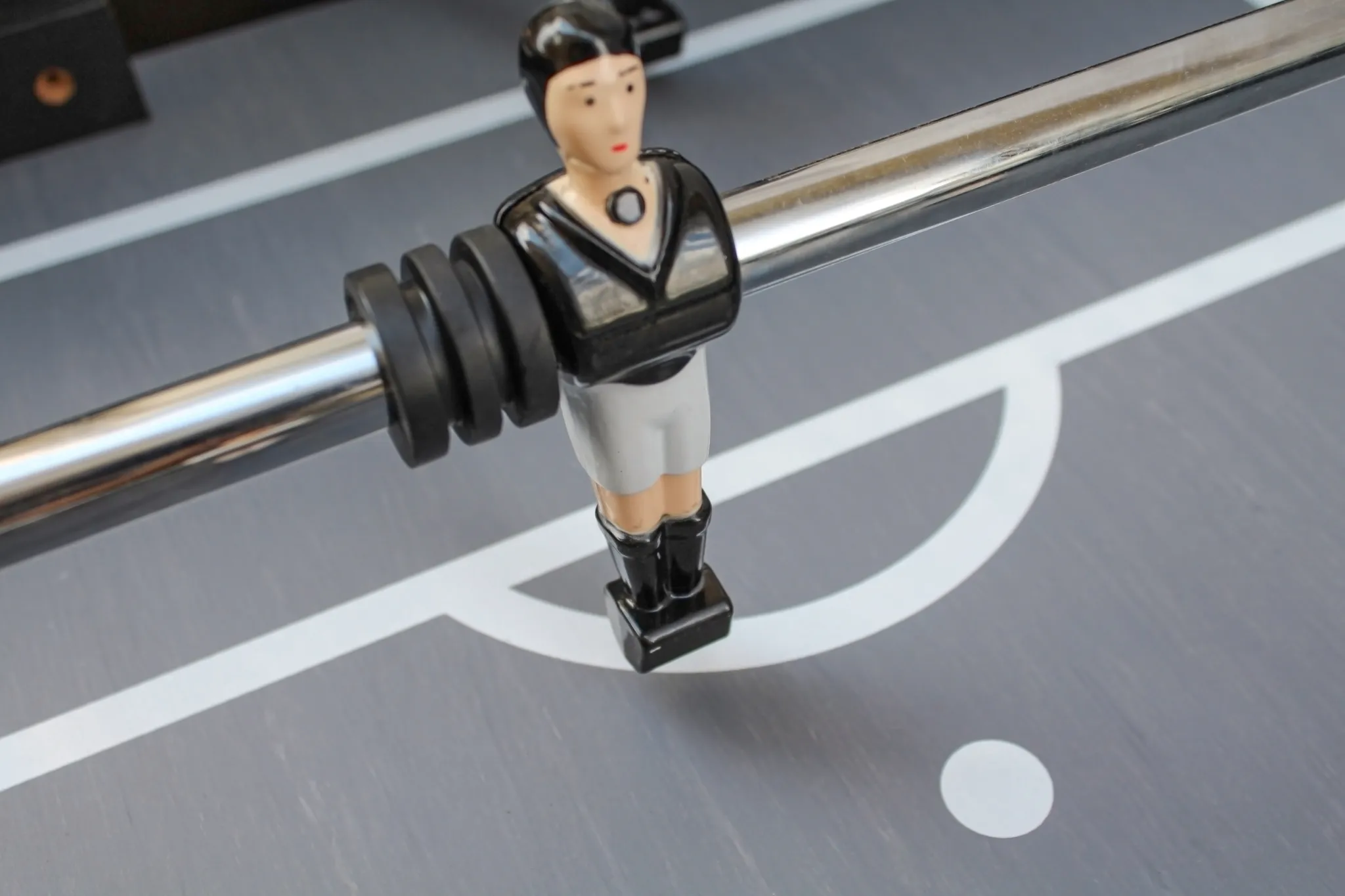
The game involves using figures mounted on rotating bars to kick a ball into the opposing goal. Table football tables can vary in size, but a table for adult play is typically 150 cm long and 90 cm wide, while smaller tables are typically built for children usage. The table usually contains eight rows of foos men, which are plastic, metal, wooden, or sometimes carbon-fibre figures mounted on horizontal metal bars. Each team of one or two human players controls four rows of foos men, one row each for the goalkeeper, defenders, midfield and strikers. Players manipulate the rods to control the figures, using them to hold up, pass or 'kick' the ball. Games begin when the ball is served through a hole at the side of the table, or simply placed by hand at the feet of a figure in the centre of the table. A coin toss is usually used to determine which player or team serves first. If it is not the first match or if the ball gets out of play or if the ball suddenly stops out, then the team scored last would get the serve after he scores one. The term for when the ball leaves the table or gets stopped somewhere out of the men-like figures’ reach is dead ball.[9] Expert players have been known to move balls at speeds up to 56 km/h (35 mph) in competition.
The rules prohibit "over 360-degree shots", or "spinning": using the palm of the hand to swiftly spin the bar all around, instead of using wrist strokes to kick the ball with a bar-mounted figure.[11] Since the establishment of the International Table Soccer Federation (ITSF), the rules have become standardised in most international competitions. The rules say that a full 360-degree rotation before or after hitting the ball is considered spinning, and thus forbidden (although, if a spinning rod hits the ball backwards into their own goal, it will count as a goal for the opposing team). If an ungrasped rod is spun by the force of a ball hitting a player figure on the rod, the spin will be considered legitimate.
The winner is determined when one team scores a predetermined number of goals, typically five, ten or eleven in competition. When playing Bonzini competitions, the target number of goals is seven and players must win by at least two clear goals.
The following arrangement is common to ITSF competition tables,though there are substantial variations, particularly in Spain and South America, where the Futbolín table model (or variants) is common and uses a different configuration. Looking from left to right on one side of the table, the configuration is usually as follows:
Children enjoy table football
Row Position Number
of men
(variant) Typical colours
1 Goalkeeper 1 (3) red or black
2 Defence 2 (3) red or black
3 Opponent's attack 3 (2) blue or white
4 Midfield 5 (4) red or black
5 Opponent's midfield 5 (4) blue or white
6 Attack 3 (2) red or black
7 Opponent's defence 2 (3) blue or white
8 Opponent's goalkeeper 1 (3) blue or white
Table football can be played by two individuals (singles), and also with four people (doubles), in which there are teams of two people on either side. In this scenario, one player usually controls the two defensive rows and the other team member uses the midfield and attack rows. In informal matches, three or four players per side are also common.
The more information, you can learn from Wikipeadia.
Know more about The International Table Soccer Federation (ITSF) is a non-profit organization based in France that promotes table soccer. The ITSF endorses soccer tables that meet requirements for international competition.